Solution-Focused Therapy

Solution-Focused Therapy

Co-authored by Dariusz Szajnert MSW, LCSW and Catherine Myers MSW, LCSWA, LCASA

What we like about Solution Focused Therapy (SFT)?

 “There is something amazing that happens in a session when a previously un-recognized or unearthed success is revealed. It’s a powerful moment to see someone in a session consciously become aware of an achievement they overlooked. That reminder of what they did, how they did it, and that they can do it again builds their confidence!”

–  Dariusz Szajnert
MSW, LCSW

“Solution-Focused Therapy is action-oriented and focused on moving forward. I enjoy collaborating with clients to create realistic, meaningful goals and celebrating the progress they've already made. Recognizing strengths and small successes often builds the confidence needed for lasting change.”

- Catherine Myers
MSW, LCSWA, LCASA


How did Solution Focused Therapy get started?

Solution-Focused Therapy is an evidence based therapeutic approach developed in the 1970’s and 1980’s by Insoo Kim Berg and Steve De Shazer. Insoo Kim Berg was a Korean born American therapist born in 1934 in Korea, moved to the USA in 1957, and became a therapist. Steve De Shazer grew up in Milwaukee in the 1940’s and 1950’s, was a therapist in California. They met as colleagues, researched together, became a couple, and later married. They moved to Milwaukee and co-founded the Brief Family Therapy Center and pioneered Solution-Focused Brief Therapy.

Solution-Focused Therapy (SFT) is a future oriented approach that emphasizes:

•  Identifying strengths
•  Building on past and existing
    successes
•  Creating practical solutions
   rather than becoming stuck in
   problems

By focusing on what is working, clients often feel more empowered to create meaningful change in their lives. SFT can be especially effective for individuals facing stress or major life transitions, as it highlights resilience and actionable steps forward. Rather than focusing on the origins of a problem, SFT encourages clients to recognize their existing resources and apply them to current challenges. The therapist is curious to learn more about the capabilities the client possesses and their abilities, rather than taking an all-knowing expert stance as a mental health professional. This collaborative approach helps foster a greater sense of control over one’s circumstances. 

Who can benefit
from SFT? 


Solutions Focused Therapy is beneficial as part of treatment for following in mental health:

• Depression
• Anxiety
• ADHD
• Autism
• Managing stress,
   including academic
   and work struggles
• Self-Esteem issues
• Interpersonal conflicts
   in relationships (including
   in families, and for couples)
• Life transitions
• Children/adolescent
   behavior issues
• Adolescents reluctant to discuss     emotions in depth
• Military personnel and veterans
• Addiction and Substance use

Who can benefit from solution-focused therapy for personal growth and positive change in Raleigh Chapel Hill North carolina

Wondering what’s the length of time for this Solution-Focused
Brief Therapy? 

For many after 4-8 sessions they may feel better and can continue changes started on their own.

Solution Focused Therapy can be used longer, beyond 8 sessions depending on the complexity of the challenges experienced, pace of progress, multifaceted issues being worked on (i.e. dual diagnosis, comorbid disorder), or evolving/more broad goals.
Couple’s therapy: when to seek relationship enhancement?


Couple’s therapy: when to seek relationship enhancement

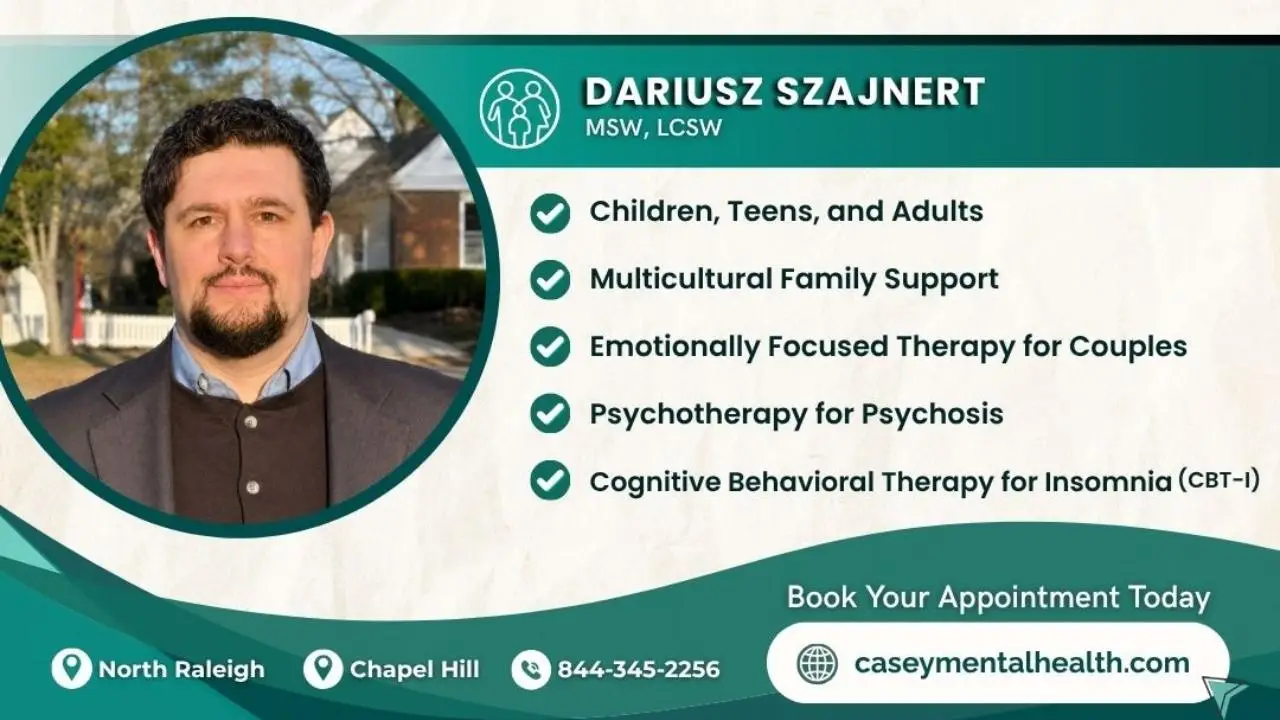
By Dariusz Szajnert MSW, LCSW

Are you feeling the same issues or arguments resurface and the breakdowns in communication are leading to widening disconnect with your partner?  If you are stuck in this pattern, it may be time to consider seeking couple’s therapy.


Common myths about couple’s therapy:

• Only woman initiate the conversation to start couple’s therapy
• Starting couple’s therapy means the relationship is in deep crisis and is on the brink of ending
• A relationship with no arguments means all is clear and the relationship is going well
• Only married couples seek couple’s therapy


Couples who seek therapy:

• Couples with a partner that pushes too much and the other shuts down
• Couples who feel more like roommates
• Couples having reoccurring arguments
• Couples recovering from betrayal or with broken trust
• Couples with major life stressors impacting their relationship (i.e. loss of family member, transitions due to parenthood, one partner has medical health conditions, one partner with PTSD).


An inspirational quote to consider by author and Humorist Dave Meurer:

"A great marriage is not when the 'perfect couple' comes together. It is when an imperfect couple learns to enjoy their differences."- Dave Meurer

I share this quote to provide hope for couples seeking therapy, and as a prelude about important aspects of couple’s therapy.

1. It’s a reminder that perfection doesn’t happen in the beginning, with two perfect people coming together, it’s a journey that a pair is on somewhere from dating to marriage learning along the way
2. perfecting in a long-term committed relationship is an active process that takes continued effort to find satisfaction/joy
3. It’s not a person’s flaws that divide a pair, but rather it’s when making efforts end/it’s about opting in everyday to recommit to your relationship with your partner


If this was a Hollywood movie or scene what would the couple be doing?

During sessions, I may ask one or both partners, imagine we were watching a movie featuring the ‘perfect’ movie couple, describe what you see happening in that scene? While I don't typically reference a specific onscreen pairing, Gomez and Morticia Addams are a fantastic example for this blog. They are simultaneously the perfect and imperfect couple. They might be misunderstood by the outside world for their macabre quirks, but they are entirely in tune, supportive, and intimately committed to one another. Comical moments with Gomez passionately responding to Morticia’s French work beautifully showing effective cues and affectionate responses. If you’re a fan of The Addams Family or want to see what this couple can teach us about healthy relationships, check out the video below.


Couple’s Therapy  - what to expect

It’s more than just improving communication, and not about fixing the other person. As an EFT trained couple’s therapist, I focus on attachment issues experienced by both partners.  Current attachment - related issues often stem from somewhere in the past and impact a partner’s current behaviors, communication, responses, and connections to their partner. Relationship enhancement comes from understanding the issues and negative patterns, realizing things missed and needed, improving communication and expanding positive cycles that can lead to strengthening of an intimate bond.
